Rush Royale: Tower Defense TD
- 4.3
- Rating
- 50.00M
- Installs
- Free
- Price

 Analysis by App-foxy
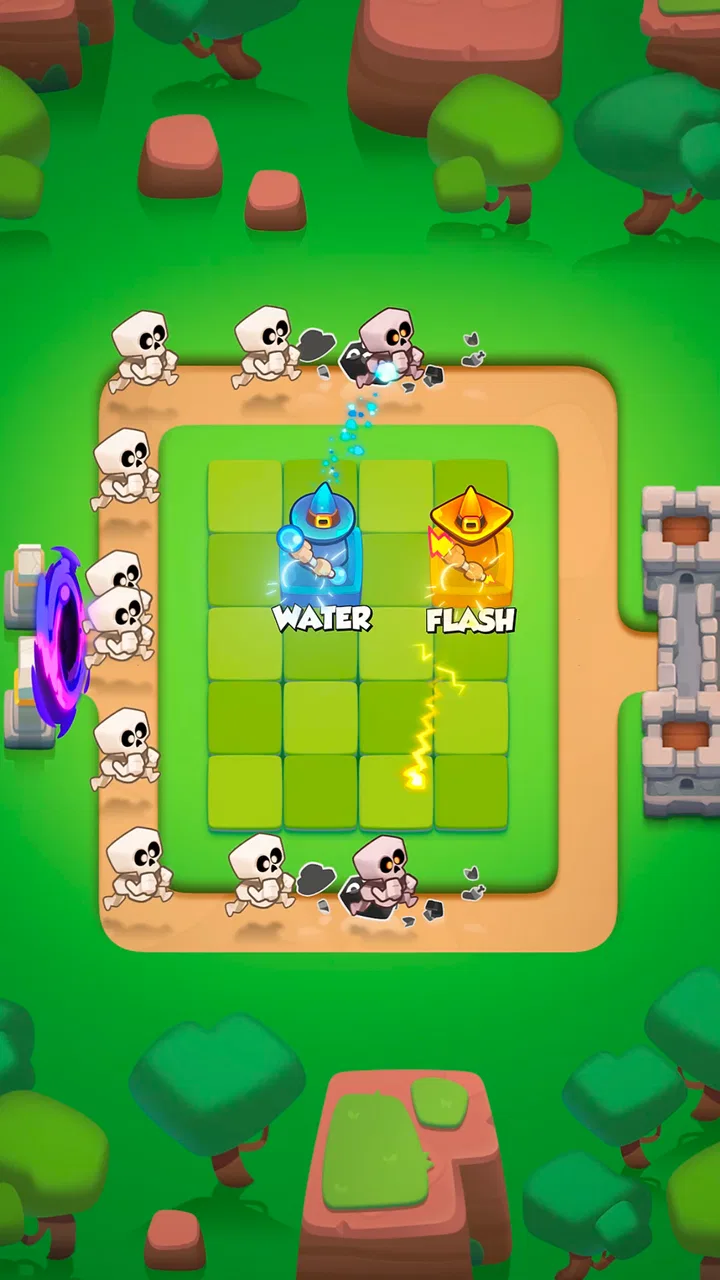
I spent time with Rush Royale: Tower Defense TD because its central idea is more interesting than a standard lane-defense game: you do not simply place a permanent tower and wait for it to fire. Your board is built around units that can be merged, rearranged, and adapted while enemies keep moving. That makes every wave feel like a small decision puzzle rather than a routine exercise in upgrading damage.
That focus gives the game its personality. It is a free strategy game from MYGAMES MENA FZ LLC, available for players using Android 7.0 or newer, and it has grown into a large mobile title with over 50 million installs. The average score sits at 4.3 from around 762 thousand ratings, which matches my impression: there is a lot to enjoy here, although the competitive structure and in-app purchase range of $0.99 to $169.99 per item will not suit everyone.
Why the merge-and-adapt board is the real hook
The most important capability is the way the battlefield forces you to make choices with an imperfect hand. Units arrive onto a limited board, and merging two matching pieces creates a stronger one. That sounds simple, but the useful decision is rarely just “merge whenever possible.” A merge can improve your damage, yet it can also remove a unit from a valuable position or produce a result that does not fit the plan you were building.
You May Also Like

 Pandora - Music & Podcasts
Pandora’s Music Is Easy to Start, but Harder to Recover
Pandora’s strength is its low-effort path from a seed to a station. Its weak spot is how much confidence it asks you to place in connection, setup, and quiet recovery.

 8 Ball Pool
 Is Built on Rivalries, Rematches, and Routine
A close look at the rivalries, rematches, shared routines, and unanswered safety questions that turn a quick pool match into a persistent mobile community.

 Samsung Music
’s Quiet Strength Is Playing What You Already Own
Its reach comes less from spectacle than from dependable access to a personal library. That simplicity is both the app’s strongest retention engine and its ceiling.

 AccuWeather: Weather Radar
AccuWeather Review: A Quick, Clear Forecast for Everyday Decisions
For everyday plans, the best forecast is the one you can understand quickly. AccuWeather makes rain timing, radar, and local conditions easy to act on, with a few trade-offs.

 Hill Climb Racing
Why Hill Climb Racing Still Turns Crashes Into One More Run
A tiny car, a bumpy hill and one more upgrade: Hill Climb Racing keeps resurfacing because its simple chaos makes every near-miss feel personal.

 AliExpress - Shopping App
AliExpress Makes Global Shopping Feel Personal, but Shoppers Bear the Risk
AliExpress turns a global marketplace into a pocket-sized discovery engine. Its reach is useful, its shopping loop compelling, and its trade-offs easy to miss.
More From Our News Desk
View All News


I found this more engaging than the fixed upgrade paths used by many traditional tower-defense games. In those games, I usually know which tower belongs on which tile and which upgrade comes next. Here, I have to read the board repeatedly. A weak unit may be worth keeping because it occupies an important firing position, while a stronger unit may arrive at an awkward moment and force me to rethink the whole arrangement.
The strongest part of Rush Royale is not the number of units on screen; it is the pressure to spend limited board space intelligently. That pressure creates a useful distinction between short-term survival and long-term stability. A quick merge can rescue a difficult wave, but saving compatible units for a better combination may produce a stronger board later. I often felt that a loss came from one impatient decision several waves earlier rather than from a single obvious mistake.
This system also makes the game approachable in short sessions. I can understand the immediate objective quickly, place units, and start making meaningful decisions without reading a long manual. At the same time, the board has enough uncertainty to reward practice. The challenge is learning when to accept an imperfect result instead of chasing an ideal arrangement that may never appear.
What a match feels like moment to moment
At the beginning of a round, the board is usually more forgiving. I can establish a basic group of attackers and watch how the first enemies behave. As the pressure rises, the value of each space becomes clearer. A unit with a useful attack may be less important than maintaining enough coverage across the board, and a merge that looks attractive can leave one side under-defended.
The practical rhythm is easy to recognize after a few games. I place or summon units, monitor the incoming wave, merge when the board becomes crowded, and adjust my plan when the result is not what I wanted. The game keeps asking whether I should improve one existing position or create another possible source of damage. That question is more interesting than simply tapping an upgrade button.
Boss encounters make this decision-making sharper. I do not treat them as ordinary waves because the board can change from comfortable to unstable very quickly. My better approach is to enter a boss wave with enough flexibility to react, rather than merging everything as soon as possible. Keeping a few useful options available can matter more than having the highest possible unit at one exact moment.
One practical tip is to avoid filling every space without a reason. A full board may look powerful, but it can also make the next merge awkward. I prefer to think of empty space as a resource. It gives me room to respond, especially when the current arrangement is already doing enough damage. This is one of those small habits that makes the game feel less random, even though the available units still influence every round.
Another useful habit is to judge a unit by its role rather than by its individual strength. A damage-focused piece, a support-oriented piece, and a unit that helps control the flow of enemies may each be valuable in different parts of a match. I get better results when I consider what the entire board needs instead of automatically favoring the unit with the most impressive number.
Where the strategy becomes genuinely demanding
The game’s strategy is not only about surviving enemies. It is also about managing the timing of decisions. If I merge too frequently, I may gain short-term power but lose a stable formation. If I wait too long, the board can become crowded and leave me unable to respond to a sudden increase in pressure. That tension is what separates a thoughtful run from a sequence of automatic taps.
I also learned to watch the shape of the board, not just the health of the enemies. A wave can appear under control while my formation is becoming fragile. If several important attackers depend on one narrow section, a bad merge or a disrupted position can expose the weakness immediately. Looking at the board as a whole helps me avoid reacting only when the danger is already visible.
For new players, the best starting goal is not to memorize every possible combination. It is to learn what happens when the board is crowded, when a merge produces an unexpected result, and when a unit is better kept than combined. Once those patterns become familiar, the deeper strategy becomes easier to understand. I found experimentation more useful than trying to copy a supposedly perfect arrangement too early.
The game also benefits from a willingness to lose while learning. Some rounds are useful because they reveal a mistake in positioning or timing. I began to improve when I stopped treating every failed match as bad luck and instead asked which decision reduced my options. That question is especially helpful in a game where the board can look strong right before it becomes difficult to manage.
How it fits into everyday play
The best scenario for Rush Royale is a player who wants a strategy game that can be played in compact sessions but still offers room for careful thinking. I can imagine opening it during a commute, taking a short break, or playing a few rounds in the evening without needing to commit to a long campaign session. The individual decisions arrive quickly, so the game does not depend on a large uninterrupted block of time to feel rewarding.
A realistic example is a short evening session after work. I might begin with one relaxed match, expecting to finish quickly, then spend the next round testing a different way to preserve board space. The first game would be about getting comfortable; the second would be about applying one specific lesson. That makes the game more satisfying than a title where each session feels identical, because I can give myself a small strategic goal instead of merely chasing a win.
It is also a good fit for people who enjoy competition but do not want a purely reflex-based game. Fast tapping helps, but it cannot replace planning. I need to decide what to merge, where to leave room, and when to accept a less-than-perfect result. Players who enjoy card battlers, tactical board games, or classic tower defense may recognize parts of the design, but the combination feels more active than a conventional tower-defense layout.
Compared with a usual tower-defense game, the trade is clear. Rush Royale offers more uncertainty and more moment-to-moment adaptation, while a traditional title often gives me greater control over the exact defenses I build. If I want to design a carefully planned maze and watch it operate according to a known blueprint, another tower-defense game may be a better choice. If I prefer responding to changing opportunities, this game has the stronger appeal.
Compared with a typical collectible strategy game, the board makes the action feel more immediate. I am not only thinking about which units belong in a long-term collection; I am deciding how to use what is available right now. That can be exciting, but it can also be frustrating when a desired result does not appear at the right time. The game rewards flexibility more than stubbornly following one plan.
Free entry, competitive pressure, and spending decisions
The game is free to start, which makes it easy to try without making an upfront purchase. The important question is not whether someone can begin, but whether they will enjoy the progression and competition over time. The presence of in-app purchases means players should approach the game with a clear personal limit, especially if they are inclined to spend when a match or progression goal feels difficult.
I would not recommend treating purchases as a solution to every strategic problem. A stronger collection may help, but it does not remove the need to understand merging, positioning, and timing. In my experience, the most useful early investment is attention: learning why a board collapsed is more valuable than immediately trying to buy a way past the problem.
That said, the competitive side can create pressure for players who want a completely even playing field. The free experience is accessible, but anyone uncomfortable with optional spending systems should think carefully before settling into the game. This is not a criticism of the core board; it is a matter of matching the progression model to your preferences.
The Teen content rating is another reason I would frame it as a strategy game for older children and adults rather than a universal family title. Parents should still consider whether the competitive structure and optional purchases fit the player’s age and habits. The game is easy to understand, but the surrounding progression can encourage repeated play, so setting boundaries is sensible.
Small decisions that improve a difficult run
My first concrete recommendation is to protect flexibility during the opening. Do not rush to merge simply because two matching units are available. Ask whether the merge improves the board’s coverage, creates a useful position, or merely clears space that could have been cleared another way. This simple pause often prevents a weak middle game.
Second, separate emergency decisions from routine decisions. When a wave is close to overwhelming the board, a quick merge may be necessary even if the result is not ideal. When the wave is under control, I use that time to prepare the next phase. Making every merge feel urgent leads to poor choices, while saving every possible combination can be just as dangerous.
Third, review the board after a win, not only after a loss. A victory can hide a fragile setup that succeeded because the pressure was favorable. I try to notice which spaces carried the match and which units contributed little. That review helps me refine a formation before a tougher round exposes its weaknesses.
Fourth, test changes one at a time. If I alter the whole board strategy after a defeat, I cannot tell what actually helped. Changing one placement habit or one merging rule gives clearer feedback. This is especially useful for players who enjoy improving through experimentation rather than copying a fixed guide.
Finally, keep the game’s uncertainty in perspective. A result that feels disappointing is not always evidence of poor play, but repeated problems usually point to a pattern. If the same side of the board keeps failing, or if every boss wave finds me without room to react, the answer is probably in my preparation rather than in one unlucky draw.
Who will enjoy it most
Rush Royale suits players who like strategy with a live decision loop. You will probably enjoy it if you want your tower defense to ask more than “which upgrade is strongest?” It is particularly appealing if you like adapting to imperfect situations, studying a board under pressure, and improving through short experiments.
It is less suitable for someone seeking a calm, fully predictable defense game. The merge system can make a carefully prepared plan change suddenly, and players who dislike randomness may find that frustrating. It is also not the best option for someone who wants a single-player experience with no competitive pressure or optional spending considerations.
The current version is 35.0.125470, and the game’s long presence on mobile is reflected in its substantial audience: it has around 23 thousand written reviews alongside its much larger rating count. I see that scale as evidence that the format has lasting appeal, but it also means newcomers are entering an established ecosystem rather than a quiet introductory game. Expect to learn gradually and avoid judging the experience by the first few matches.
My recommendation is straightforward: try it if the idea of managing a changing board sounds more appealing than placing fixed towers and watching a predetermined plan unfold. Give yourself time to learn when not to merge, how to preserve space, and why a strong unit can still be wrong for the current formation. Those lessons reveal the depth that the brief store summary does not show.
After playing it, I see Rush Royale: Tower Defense TD as a clever mobile strategy game with a clear identity. Its best feature creates real decisions in nearly every wave, while its free-to-play structure and competitive pressure are genuine considerations. I would recommend it to players who enjoy tactical adaptation and short, repeatable sessions; I would steer others toward a more predictable tower-defense game if they prefer complete control. For the right player, the board’s uncertainty is not a nuisance—it is the reason to keep coming back.
FAQs for Rush Royale: Tower Defense TD
01What is the basic gameplay of Rush Royale: Tower Defense TD?
Rush Royale: Tower Defense TD is a unique blend of tower defense and card collection. Players must strategically place towers, represented as cards, to fend off waves of enemies. Each card has distinct abilities and upgrades, requiring players to think tactically about their defenses. The game incorporates both single-player and cooperative modes for varied gameplay.
02Is Rush Royale free to play, and are there in-app purchases?
Yes, Rush Royale is free to download and play. However, it offers in-app purchases that can enhance gameplay, such as new cards, upgrades, and cosmetic items. While purchases can accelerate progress, they are not mandatory for enjoying the core experience and can be earned through regular gameplay.
03What are the system requirements for Rush Royale on Android and iOS?
For Android devices, Rush Royale requires Android OS 5.0 or higher, with at least 2GB of RAM for optimal performance. On iOS, the game runs on iOS 10.0 or later, compatible with iPhone, iPad, and iPod touch. Ensure your device meets these requirements for the best gaming experience.
04How does the multiplayer feature work in Rush Royale?
Rush Royale offers an engaging multiplayer mode where players can team up or compete against each other. In co-op mode, players join forces to fend off waves of enemies, while PvP mode pits them against each other to see who can survive the longest. Multiplayer adds an exciting dynamic to the game, offering endless replayability.
05Are there regular updates and events in Rush Royale?
Yes, the developers frequently update Rush Royale with new content, including special events, new cards, and balance adjustments. These updates keep the game fresh and engaging, providing players with new challenges and rewards. Staying engaged with the community can also offer insights into upcoming features and events.
Pros
- Engaging gameplay with unique card mechanics.
- Frequent updates keep the game fresh.
- Vibrant graphics enhance the experience.
- Diverse character roster adds strategic depth.
- Easy to learn
- hard to master dynamics.
Cons
- Can be pay-to-win at higher levels.
- Occasional connectivity issues.
- Limited in-game chat functionality.
- Resource grind can be time-consuming.
- Ads can interrupt gameplay flow.

Rush Royale: Tower Defense TD
Gallery